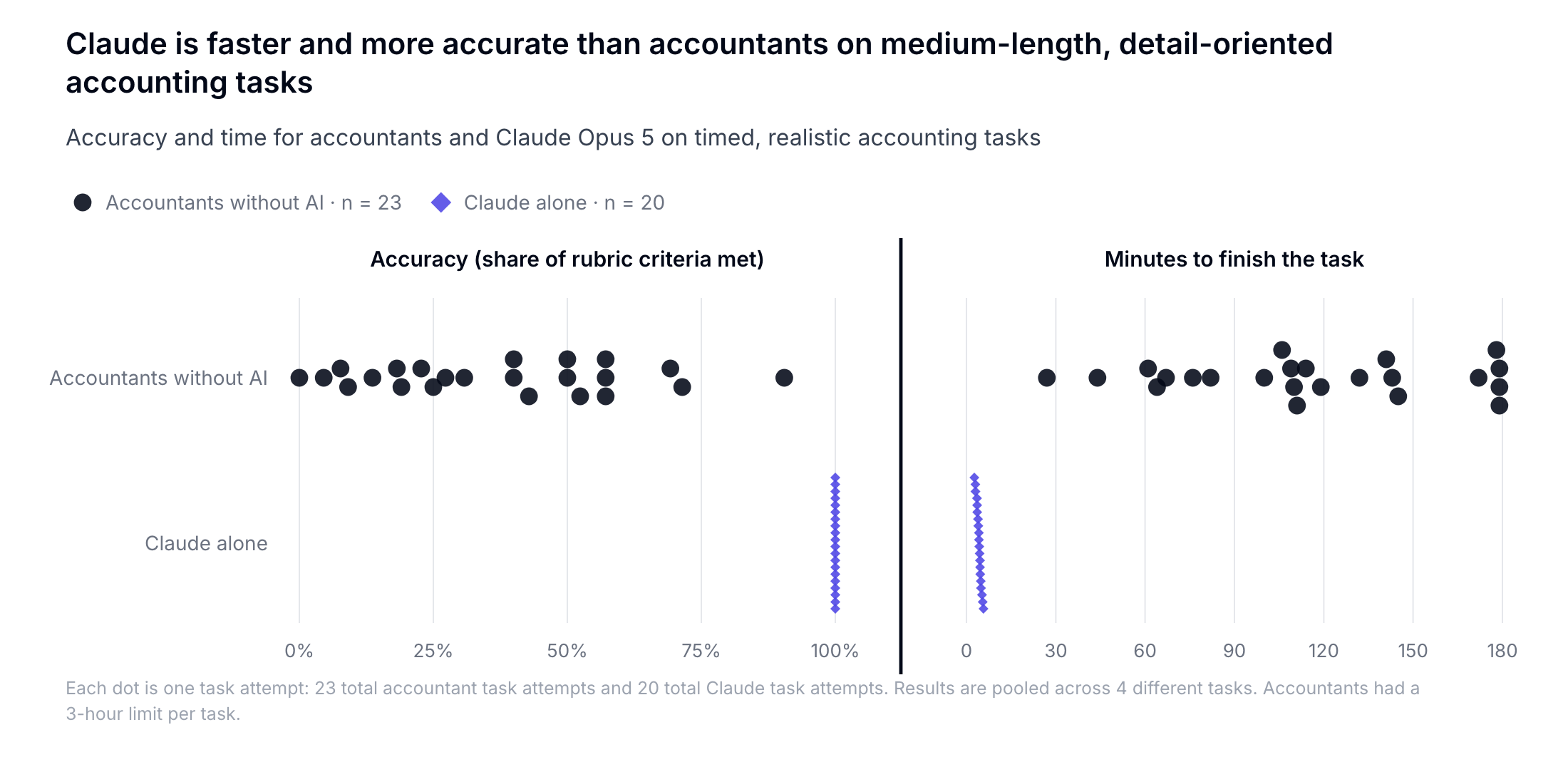
Mercor’s October 1 study gives the argument over AI productivity a more precise starting point: compare models with people on the same work. Its result favors frontier AI on a small collection of structured accounting tasks. The larger significance is methodological. Model scores mean more when the human baseline, working conditions, and definition of success are visible. Mercor’s study and paper.
A bounded result with an unusually clear comparison
Mercor hired 12 licensed CPAs, averaging about five and a half years of experience, to tackle four simplified month-end-close scenarios derived from APEX-Accounting. It reports roughly 37% average human accuracy. Its chart shows Claude Opus 5 scoring 100% across 20 attempts, each under ten minutes. The setting excluded accumulated workplace context and help from colleagues. Mercor explicitly says the result does not establish that accountants are replaceable.
That boundary belongs near the result, not in a footnote after the headline. The participants and models faced a particular test of file search, instruction following, and detailed calculation. A complete occupation contains other activities and obligations. A reader who treats the two units as interchangeable will draw a much larger conclusion than the experiment supports.
The underlying APEX-Accounting benchmark, developed with Ramp, contains 160 tasks across ten simulated companies. The four simplified scenarios in the human comparison are therefore a distinct experiment, not a human evaluation of the entire benchmark. Keeping those denominators separate prevents a narrow result from becoming a claim about every accounting workflow.
The human baseline is part of the instrument
Imagine evaluating a navigation system against drivers who receive neither local knowledge nor permission to ask directions. Such a comparison could still be fair for a narrowly defined task. It would not answer every question about transportation. Likewise, removing workplace context can clarify a model comparison while also changing the activity being compared. Both statements can be true.
For model developers, human results are useful beyond marketing. They can expose ambiguous instructions, a grading rule that punishes reasonable interpretations, or tasks that require more context than their authors realized. If both experienced people and models fail in the same way, the next step may be improving the task specification. If their errors differ, the benchmark can identify complementary strengths worth testing in collaboration.
The stronger research design would therefore preserve several baselines. One could measure an unaided individual, another an individual with normal workplace resources, and another a person using the model. Those conditions would reveal whether AI substitutes for an isolated skill, improves an existing workflow, or changes which skills the workflow requires. This is a proposed extension, not a result of the published study.
From cheap output to accepted output
The commercial unit should be a result that meets the organization’s acceptance standard. A low generation cost is only one component. Someone must provide inputs, identify missing context, review exceptions, and decide what to do when outputs disagree. Those activities can shrink as models improve, but they should be measured rather than assumed away.
Consider two hypothetical systems. One produces results very cheaply but requires a complete manual audit. The other costs more to run but makes its evidence easy to verify and reliably identifies cases it cannot resolve. Depending on the task, the second could deliver a lower cost per accepted result. A benchmark that reports only inference spending would miss that advantage.
This is also why confident error detection matters to model training. A system that performs well on ordinary cases but cannot recognize unfamiliar ones may transfer review effort to the hardest part of the workflow. Training and evaluation should test whether uncertainty is appropriately calibrated, including on new file layouts and incomplete records. A refusal is useful only when it accurately identifies a case needing help.
What buyers and builders should demand next
The next useful experiment would run the same acceptance criteria across new organizations and repeated reporting periods. It would separate correct first attempts from corrected attempts and record the human time needed to reach an approved result. That would connect capability gains to the operating decision a business actually faces.
The evidence to watch
Look for larger participant groups, ordinary workplace resources, fresh tasks, and comparisons of human-only, model-only, and assisted workflows. The meaningful breakthrough is not simply a machine winning an exam; it is a reproducible reduction in the cost of work people can rely on.
References
Questions, news tips or corrections? Contact info@frontieraireview.com.