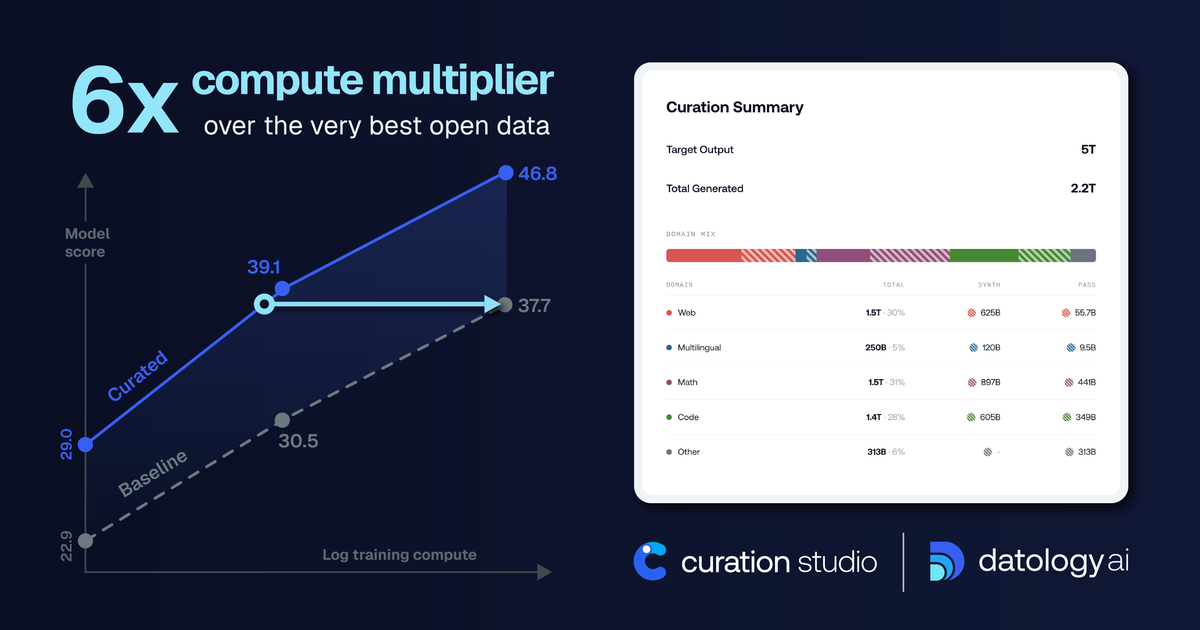
Datology launched Curation Studio on October 9 with a proposition aimed squarely at companies building their own models: improve what the model learns from before spending more on its size. The company says its system packages data selection, synthetic generation and mixture design into a configurable workflow running in a customer’s private cloud. The commercial question is whether curation can move from a research advantage to a repeatable budget decision. The launch announcement establishes the offering; it does not independently establish its promised savings.
A different place to look for efficiency
Model efficiency is usually presented through parameters, numerical precision or serving speed. There is another intervention upstream: decide which examples deserve to consume a training step. Repeated, irrelevant or weak examples can still incur processing and learning costs. Our analysis is that a data supplier becomes strategically interesting when it can demonstrate which expenditure disappears without removing a capability the customer needs.
In its separate October research report, Datology says curated models matched the strongest baseline’s performance using one-sixth of the training compute in its experiments. That baseline mixed 39 public datasets. This is a company-reported comparison under a particular recipe, not a transferable sixfold discount on every training project. Its significance is the attempted comparison: changing data while controlling other parts of the experiment. Datology’s research report describes the test.
The scarce asset is a useful target
For a business, “better data” has no meaning without a definition of better performance. Consider an illustrative manufacturer training a model to interpret maintenance records. Elegant general prose is not necessarily the priority. Distinguishing a repeated fault from a resolved one, preserving component identifiers and recognizing incomplete evidence may matter more. Selecting examples against those goals is a different activity from removing formatting errors.
That creates a less obvious advantage for an incumbent with domain knowledge. It may already know the questions worth testing, the expensive mistakes and the difference between a plausible answer and an acceptable one. Those judgments can guide a training corpus. A startup with a larger collection of generic documents may still lack the evaluation target that makes the collection useful. This is a potential advantage, not evidence that every corporate archive is valuable.
Count the cost of finding the recipe
A buyer should compare complete experimental budgets. Curation itself consumes compute, storage and engineering time. Several candidate mixtures may need training before a winner emerges. The relevant denominator is the cost of reaching an agreed capability threshold, including rejected experiments. Quoting only the final successful run would hide part of the bill.
The same accounting applies to a smaller resulting model. It can offer a recurring serving advantage if it meets the workload’s requirements, but that benefit depends on request volume, latency targets and operational overhead. A specialized model used rarely may never recover a large development expense. A frequently used model with stable requirements has a different business case. Neither conclusion follows automatically from a benchmark win.
A private corpus is not a permanent moat
Data ownership and data usefulness should be evaluated separately. A customer can retain its documents while depending on a vendor’s selection logic, generation models and undocumented defaults. The procurement question becomes whether the organization can reproduce the mixture, inspect changes and continue training if the relationship ends. Versioned recipes and exportable lineage could matter as much as a private-cloud deployment.
There is also a research risk: optimizing too tightly around familiar tests can produce brittle specialization. A convincing deployment study would retain an untouched evaluation set and deliberately test adjacent tasks. The business wants the model to become more competent in its domain without quietly losing the ability to handle unusual wording or incomplete context.
What this changes for model builders
The broader implication is a shift in where an AI team assigns authority. Dataset composition cannot remain a handoff between a data warehouse and a training engineer. Domain specialists, researchers and evaluators need to agree on the capability being purchased. If curation consistently reduces total cost at that threshold, it becomes part of model strategy. If the gains vanish outside the vendor’s chosen tests, it remains a promising experiment.
The evidence to watch
Look for customer-reproducible comparisons using unchanged evaluation sets, total curation-plus-training cost, and performance on tasks outside the optimization target. Those results would show whether the reported multiplier survives a business’s actual workload.
Questions, news tips or corrections? Contact info@frontieraireview.com.