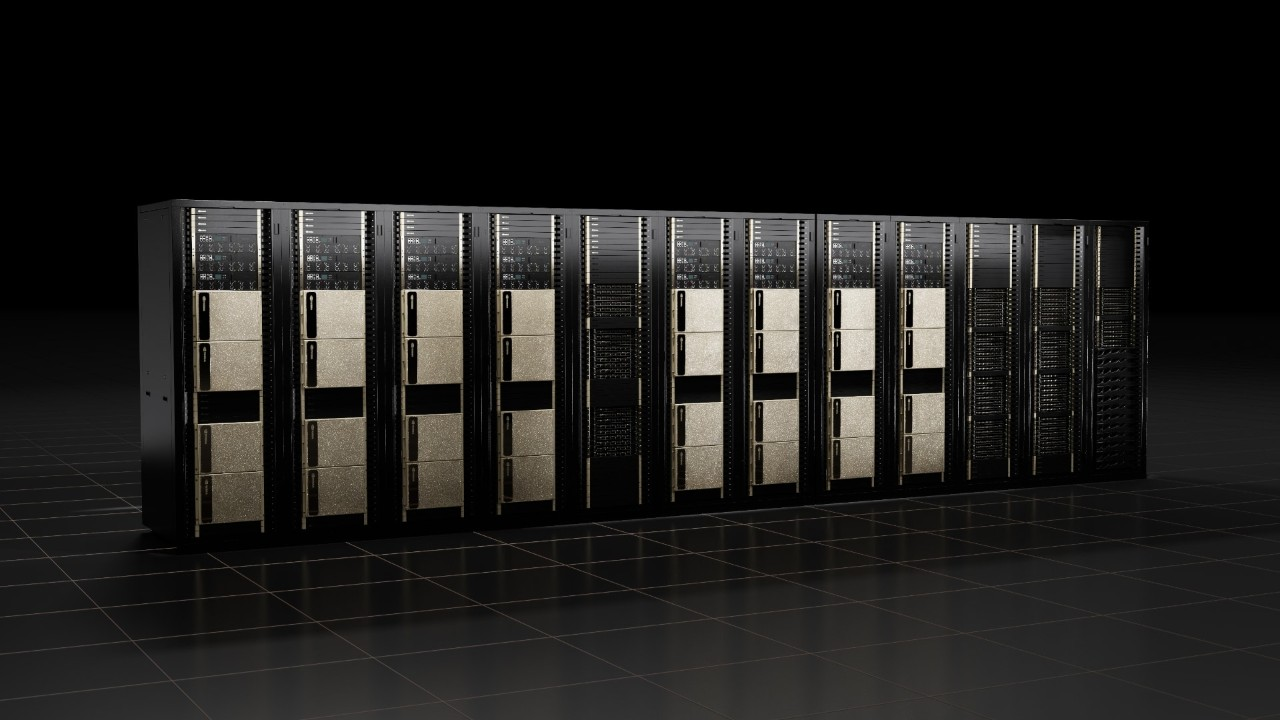
A model’s working memory can become the constraint before its weights do. As conversations grow, the stored attention state consumes capacity that could otherwise support additional sessions. On September 16, SGLang, Qwen and NVIDIA published an experimental four-bit cache implementation that addresses this pressure. Its most useful finding is not an uncomplicated speed record. It is a measurable trade between memory, concurrency and answer quality.
The result is narrower than “four-bit AI”
The experiment changes the attention cache to NVFP4 while retaining FP8 model weights. Its packed values and block scales occupy about 56% of the corresponding FP8 cache storage before other overheads. For Qwen3.8-27B, the reported SWE-bench Verified score fell from 77.8% to 76.2%. Some other measurements moved less. The implementation remains experimental; these results do not establish that every model or workload tolerates the change. The teams’ published implementation and measurements.
SGLang’s cache-quantization documentation separates the cache representation from other model configuration choices. Its hierarchical-cache documentation describes a complementary strategy: extending storage beyond the accelerator. One reduces the space occupied by state; the other changes where state can live. They should not be treated as identical optimization knobs.
The economics depend on what was binding
Our interpretation is that the benefit will vary with the constraint a deployment actually faces. A service short of live-session capacity has a different problem from a service with ample memory but slow prompt processing. A memory-saving technique can be valuable for the first and barely noticeable for the second. Buying capacity without first identifying that distinction risks paying to move the wrong bottleneck.
Imagine an internal assistant serving employees who repeatedly return to large document collections. Its operator should ask whether working state survives between turns and how much recomputation occurs after eviction. A one-shot benchmark with unrelated short prompts cannot answer that question. The useful comparison follows complete sessions, including idle periods and the arrival of competing users.
A small quality change is not a small business change
A one-percentage-point movement in a broad benchmark says little about where errors concentrate. If the lost answers concern easy-to-detect mistakes, a retry might absorb them. If they concern subtle instructions or rare but consequential cases, the same average change can be costly. The right acceptance threshold comes from the task and the checking process, not from a universal tolerance for lower precision.
This creates a practical testing obligation. Teams should compare paired outputs, group failures by type and rerun a held-out task set rather than only a public aggregate. A deployment that retains enough accuracy for document classification may still fail a repository-editing trial. That would be evidence for separate serving profiles, not proof that the optimization either works everywhere or should be abandoned.
Measure the bill after retries
The financial denominator should be accepted work. If a compressed-cache configuration handles more sessions but triggers extra repairs, the additional inference and review must be included. So must engineering time required to qualify and monitor the new configuration. The initial saving may still be substantial; the point is to measure it at the boundary where the customer receives a usable result.
There is also a product-design consequence for model APIs. Exposing a choice between a carefully qualified efficiency profile and a higher-fidelity profile could be useful where customers understand the trade. Quietly altering numerical behavior while continuing to advertise only the same model name makes comparisons harder. Providers can distinguish themselves by making the serving configuration and its measured limits inspectable.
For model builders, cache behavior deserves attention during development rather than after release. A model that is cheap to store but expensive to keep active can disappoint in long-running workloads. The deployed system’s memory profile is part of its practical capability, even though it is absent from many headline model comparisons.
The evidence to watch
The next convincing result would pair long-session cost measurements with failure analysis on customer-relevant tasks. Watch for reproducible memory savings, actual cache reuse and total repair costs—not a single maximum-context demonstration.
Questions, news tips or corrections? Contact info@frontieraireview.com.