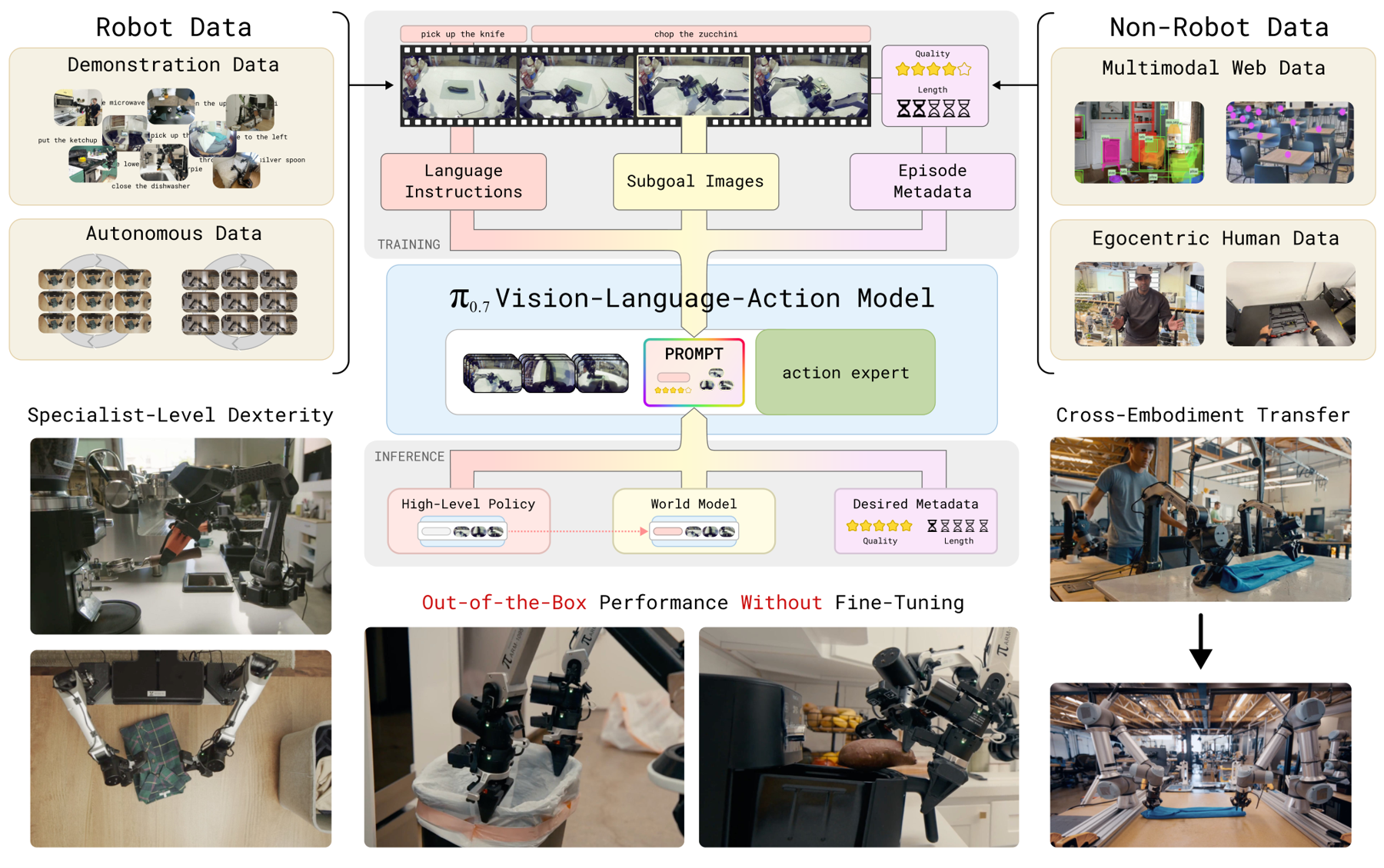
Physical Intelligence’s π0.7 research asks a commercially important question about robot foundation models: how much new behavior can be obtained by changing the instruction rather than changing the weights? The paper, first submitted on April 16, describes a steerable vision-language-action model that uses richer context to combine learned capabilities. It is a research result about model generalization, not a declaration that arbitrary physical tasks have been solved.
The company-authored paper reports performance across language following, dexterous tasks and transfer between robot embodiments. Its prompts can include more than a task name: intermediate language, images of desired subgoals and information about how an episode was performed. The distinction is between telling a model what outcome to pursue and giving it enough context to select an appropriate way of pursuing it.
More experience is not automatically clearer experience
Imagine a dataset containing several ways to place the same object. Some recordings favor speed, others precision; some show successful recovery, while others end in failure. If every example carries the same short task label, the learner receives little explanation of why the behavior differs. Adding more recordings can increase diversity without resolving that ambiguity.
π0.7’s technical description makes conditioning central to its approach. The training context helps distinguish strategies and qualities of execution across heterogeneous data. The model can then be steered with corresponding information at runtime. This is a model-and-data design choice, not simply advice to write longer prompts for an otherwise unchanged system.
The economic issue is the cost of the next capability
For a company building physical AI, the first useful demonstration is only a beginning. The harder business question is what must be repeated to add another task. If every addition needs a substantial new recording campaign and a specialist training run, expansion remains labor intensive. If some additions can reuse existing skills through instruction, the marginal cost could fall.
Our assessment is that this is the promising implication of steerability. It creates another adaptation option between accepting a model exactly as delivered and undertaking a full fine-tuning project. A developer might supply better intermediate guidance, test the resulting behavior and reserve new action demonstrations for genuinely missing skills. That is a hypothesis about development economics, not a cost saving established by the paper.
Human guidance still belongs on the balance sheet
A model that succeeds with step-by-step coaching has demonstrated something different from one that independently interprets a broad objective. Both can be useful, but they carry different operating costs. A team should record the time spent designing instructions, the interventions required during execution and whether the instructions transfer to another instance of the task.
Consider a hypothetical operator teaching a robot a new packing sequence through language. If the guidance works repeatedly after a short preparation period, it may replace more expensive data collection. If the operator must continuously rewrite instructions for each item, the labor has merely changed form. Calling both outcomes generalization would conceal the distinction that matters to a customer.
Dataset interpretation could become a competitive asset
The model-building consequence extends beyond the amount of data collected. A company that preserves why an episode was performed a certain way may have a more reusable training asset than one that stores only video and an outcome label. Context can make differences between demonstrations informative rather than contradictory.
That suggests a practical research question for data providers and model teams: which additional annotations produce enough controllability to justify their collection cost? Richer labels are not free. They require consistent definitions and quality checks, and they can introduce their own errors. The right experiment compares several annotation budgets against resulting transfer performance, rather than assuming that maximum descriptive detail is always best.
The evidence to watch
Compare a frozen generalist model using new instructions with a specialist trained on new demonstrations, under the same human-time budget. Hold out objects and environments, repeat trials and report coaching as well as failures. The decisive result would be new capabilities acquired with measurably less total effort—not an isolated instance of a robot responding to an elaborate prompt.
References
Questions, news tips or corrections? Contact info@frontieraireview.com.