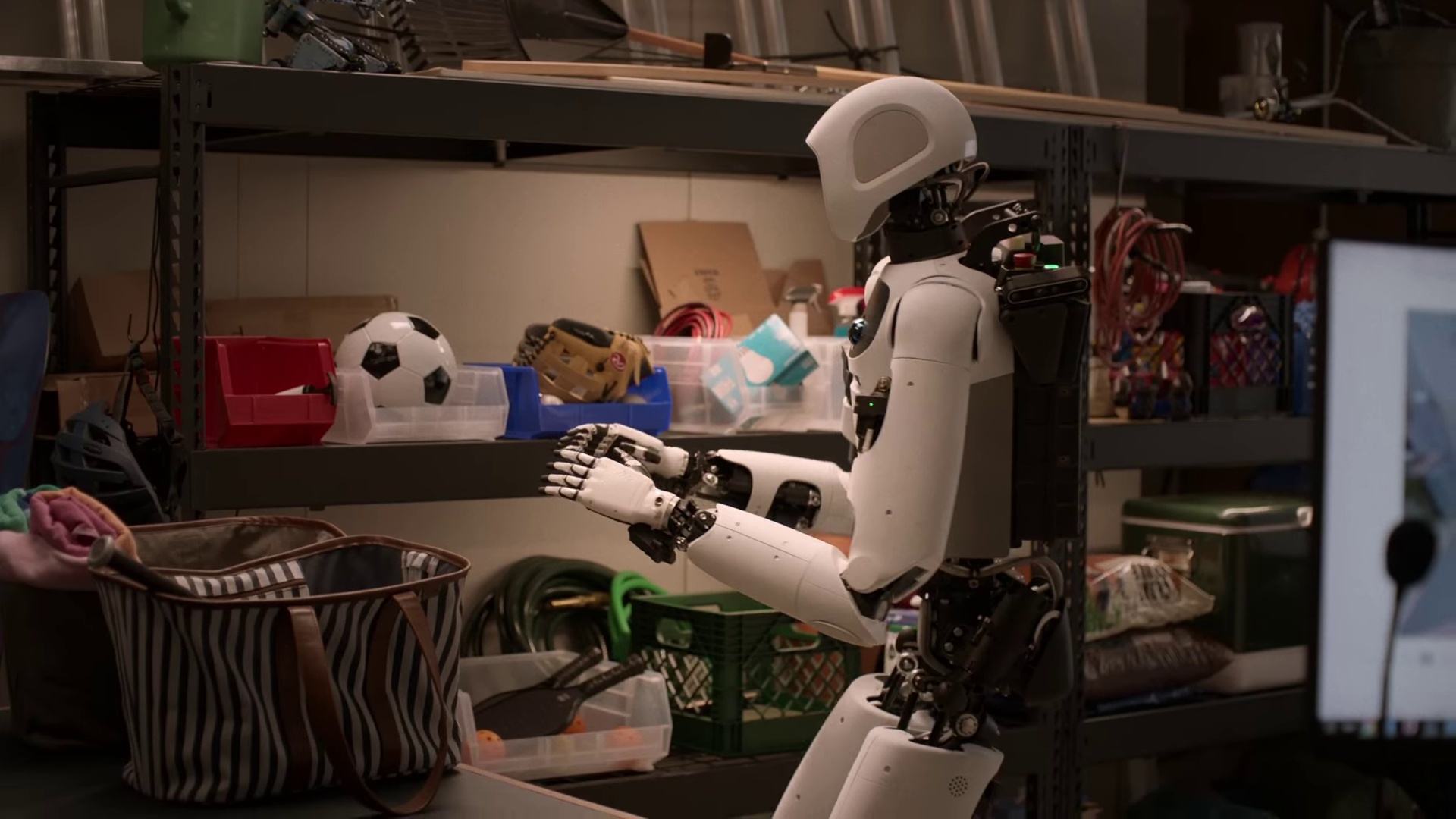
Google DeepMind’s July 30 introduction of Gemini Robotics 2 extends its vision-language-action work from upper-body manipulation toward whole-body control. But the strategically important claim is less visible than a walking humanoid: learned capabilities can be adapted across different physical bodies. If that transfer becomes reliable, a model developer’s addressable market no longer has to be rebuilt one robot configuration at a time.
The announcement separates three systems: a VLA for actions, an embodied-reasoning model for higher-level coordination, and an efficient on-device VLA. DeepMind says its on-device model can adapt to new bi-arm embodiments with a few hours of adaptation, typically using fewer than 200 examples. The action models are offered to early-access partners; the public reasoning model is a different component.
Why a new body is a new distribution
A language instruction can remain identical while the action needed to execute it changes substantially. Arm length, joint limits, camera position and gripper geometry all affect a robot’s feasible movements. A policy that has learned to reach around an obstacle with one machine cannot simply replay the same joint commands on another.
That is why cross-embodiment transfer matters at the model layer. The learning system must preserve something more abstract than a memorized trajectory while still producing commands specific enough to move safely. The desired separation is between knowledge about a task and knowledge about a body. In practice those forms of knowledge interact, so successful transfer must be measured rather than assumed.
The commercial bottleneck is adaptation work
Consider a hypothetical model supplier working with three robotics manufacturers. If every new machine requires extensive new recordings, tuning and validation, the supplier’s engineering workload grows alongside each partnership. A transferable model could reduce the marginal learning effort even though mechanical integration and safety validation remain necessary.
Our assessment is that this is the strongest economic interpretation of the release. The value lies in shortening the path from an existing learned capability to acceptable performance on another embodiment. That would let a model company reuse more of its research and data investment. It could also give hardware developers a more credible alternative to maintaining the entire learning stack themselves.
The model boundary deserves careful attention
A VLA produces actions from perception and instructions. A reasoning model can organize a task, call tools or decide that assistance is needed. Combining them may be useful, but it means a successful demonstration belongs to a system with several components. Buyers need to know which component is changing when performance improves.
Suppose a robot succeeds more often after a new high-level planner is introduced, while the action model remains unchanged. That is a meaningful system advance, but it does not prove that motor learning has improved. Conversely, a better action policy may reduce execution errors without improving the planner’s choice of task. Separating these contributions makes research results easier to reproduce and commercial dependencies easier to understand.
Transfer speed is only half the test
A short adaptation process is attractive only if the resulting policy is sufficiently capable. The comparison should report the amount of new data and the performance retained, alongside the cost of collecting and checking that data. It should also show the tasks where adaptation fails. A small number of examples can be expensive if each requires expert setup or carefully controlled conditions.
Whole-body behavior adds another reason for caution in evaluation. Reaching, balancing and moving through space create coupled errors that a tabletop benchmark may not expose. The appropriate business metric is not how quickly the first impressive video appears. It is how much work is needed to establish a dependable capability boundary on the new embodiment, including recovery and human intervention.
The evidence to watch
Look for repeated transfer studies across unfamiliar machines, with complete adaptation-data counts, collection effort, task success and intervention rates. Compare against training or fine-tuning a specialist under the same budget. A consistent reduction in total adaptation effort would be stronger evidence of a scalable model business than any single demonstration of whole-body motion.
Questions, news tips or corrections? Contact info@frontieraireview.com.